Age of Peace
New Life as a Max Level ArchmageThe Age of Peace is the post-Cataclysm era established after the Party of Heroes defeated the Seven Cataclysms. It is not merely a chronological label but the governing condition of the changed world that Vivisari Vexaria encounters after awakening a century later: a kinder age whose prosperity is publicly commemorated, whose former terrors have become historical spectacle, and whose peace carries the quiet shock of having outlasted the heroes who created it.
Definition and Historical Break
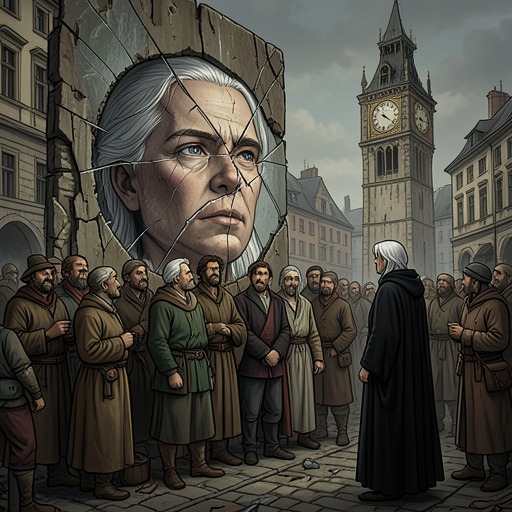
The Age of Peace is defined against the Age of Chaos, the period preceding it, when the Cataclysms still tore through the world. When Vivisari Vexaria asks for the meaning of the older era, the answer is deliberately straightforward: it was the time before peace, when the disasters remained active. This contrast makes the Age of Peace a historical boundary rather than an abstract ideal. Its beginning is associated with the end of the Cataclysms and with the arrival of a more humane condition for ordinary inhabitants.
The transition is also tied to the Party of Heroes' victory. Vivisari Vexaria knows that the central purpose of the campaigns in which she participated was to defeat the Seven Cataclysms, and the historical world confirms that this victory produced lasting consequences. The heroes did not simply complete an adventure and disappear from the narrative; their success became the foundation on which the subsequent century was built.
Peace Day and Collective Remembrance
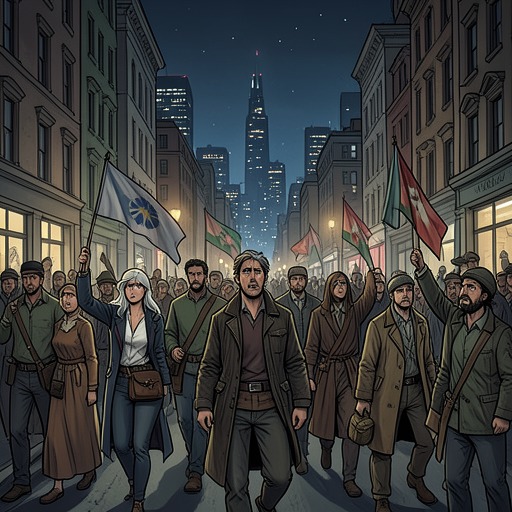
The Age of Peace is publicly marked by Peace Day, a festival described as a remembrance of the world's good fortune, the end of the Age of Chaos, and the advent of a kinder age. In Prismarche, the celebration lasts an entire week, and the one-hundred-year anniversary gives it exceptional scale. The festival therefore performs two functions at once: it celebrates present security and preserves a simplified communal memory of the catastrophe that preceded it.
As the festival intensifies, citizens flood the streets after completing their daily duties and abandon ordinary restraint. The celebration is presented as a citywide release, made possible by the fact that a hundred years have passed without the Cataclysms ravaging the world. The Age of Peace is thus experienced bodily and socially, through crowded streets and public festivity, rather than only through official chronology.
Yet the newer generation has no firsthand knowledge of the horrors that once crawled across the land. The Flesh-Weaver's Rampant Genesis, the Reaper of the Lost Harvest's Crimson Blight, and the Ashen Hierophant's Great Conflagrations survive for most citizens as inherited history. Their names still carry cultural authority, but direct trauma has given way to commemorative distance. Peace Day preserves the memory of suffering while also demonstrating how thoroughly peace has transformed the population's relationship to it.
Former Monsters as Historical Spectacle
The festival parade makes the cultural transformation especially visible. The Cataclysms are cheered and jeered as parade figures, despite having once represented mass death and devastation. The Ashen Hierophant remains the most faithfully represented of the former Cataclysm Monarchs because Prismarche remembers his presence with particular force: his fires destroyed more lives than disease, age, and famine combined, devastated entire continental expanses, and left scars that still endured a century later.
The celebratory treatment of such figures strikes Vivisari Vexaria as strange because she remembers the Cataclysms as genuine monsters rather than harmless relics. Nevertheless, the absence of solemnity or authentic relief confirms that the disasters belong to the past for nearly everyone around her. The parade's irreverence is not evidence that the old suffering was insignificant; it is evidence that the Age of Peace has lasted long enough for catastrophe to become representable, repeatable, and safe to display.
The contrast extends beyond the Ashen Hierophant. Fractured Time and the Shattered Oracle are remembered as a warning against looking too deeply into profound and esoteric magic. Its victims could be trapped for millennia in alcoves of stuttering time, making it less destructive in scale than some Cataclysms but more horrifying in its intimate distortion of existence. The festival compresses these distinct forms of terror into a shared historical pageant, revealing both the durability of public memory and its unavoidable simplification.
Vivisari Vexaria's Encounter with the New Era
For Vivisari Vexaria, the Age of Peace is inseparable from dislocation. A century has passed, explaining the transformed city and its technological advances, while the festival announces that the world has not been waiting for her return. She learns that death is permanent, that she remains famous among the populace, and that there is no apparent sign of other players. The Party of Heroes, her old party, is dead and gone.
This recognition changes the meaning of her victory. The campaign succeeded, but its consequences continued without the people who achieved it. Vivisari Vexaria is at once the celebrated Sorceress of public memory and a living survivor displaced from the age that made her famous. The title used for her by the population confirms her historical importance, yet the passage of time makes that fame emotionally remote: she is remembered as a figure from a completed era while standing in a world that regards her achievements as settled history.
The practical conditions of peace are equally revealing. She emerges without money because she did not carry any into the raid, and her immediate destination is the bank. From there, she considers traveling to the capital to discover what happened to her guild and item stash, though that is only a medium-term goal. The Age of Peace has given her a stable society to return to, but not a personal place within it. Its order offers safety and continuity while leaving her materially stranded.
Meaning and Narrative Function
The Age of Peace creates a powerful temporal reversal. The heroes' victory, which would ordinarily form a triumphant ending, becomes the beginning of a historical aftermath that excludes them. Peace is therefore both the reward for the Party of Heroes' labor and the condition under which their personal world disappears. The passage from chaos to peace improves life for the population, but it produces grief and estrangement for Vivisari Vexaria, who discovers that saving the world did not preserve her relationships, possessions, or era.
Its most important significance lies in the tension between lived history and inherited memory. For the citizens of Prismarche, the Cataclysms are parade material and Peace Day is a joyous civic festival. For Vivisari Vexaria, they remain remembered realities whose violence cannot be reduced to spectacle. The Age of Peace does not erase the past; it changes the emotional distance at which the past can be encountered. Through that contrast, the era becomes both a testament to the Party of Heroes' success and a measure of the cost of surviving long enough to become a legend.